
Nigeria At 66: Between The Promise Of Independence And The Burden Of History
By Abdulkarim Abdulmalik
On October 1, 2026, Nigeria will mark 66 years of independence from British colonial rule. Sixty-six years is long enough for a nation to have accumulated achievements, disappointments, wisdom, wounds and, hopefully, lessons.
Nigeria’s story since 1960 is not a simple story of success or failure.
It is a complicated national journey—one containing remarkable achievements alongside painful failures; moments of unity alongside episodes of profound division; democratic aspirations alongside military interruptions; enormous natural and human resources alongside persistent poverty and insecurity.
The 66th anniversary therefore provides an opportunity to look beyond the flags, speeches and ceremonial celebrations and ask a more fundamental question : What has Nigeria made of its independence, and what must Nigerians do differently to build the country that independence promised?
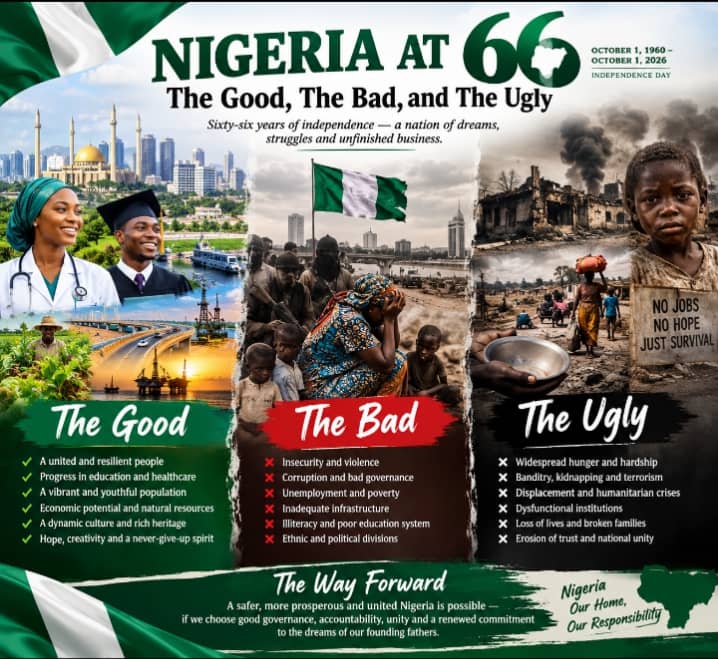
*The Good: A Nation that Refused to Disappear*
Nigeria’s first achievement may simply be its survival.
The country has passed through military coups, a devastating civil war, ethnic and religious conflicts, economic crises, political instability and prolonged periods of military dictatorship.
Yet Nigeria remains one political entity and, since 1999, has sustained more than two decades of uninterrupted constitutional democratic rule.
That achievement should not be dismissed.
Nigeria has also produced generations of accomplished citizens who have made their mark in medicine, science, engineering, education, business, journalism, entertainment, sports, diplomacy and technology. Nigerian professionals and entrepreneurs continue to contribute significantly both at home and internationally.
The country has also witnessed substantial changes since 1960. Telecommunications, financial services, higher education, transportation, entrepreneurship and digital technology have expanded dramatically. Nigeria’s population, now estimated by the World Bank at more than 237 million, represents both an enormous challenge and an extraordinary reservoir of human potential.
There is another achievement that deserves recognition: Nigeria’s capacity for national reinvention.
After the civil war came reconstruction. After military rule came democratic government. After economic crises came reform efforts.
After periods of stagnation came new attempts at industrialisation, diversification and technological transformation.
The present administration is again pursuing major economic reforms, while the Federal Government says the next phase is to translate macroeconomic stabilisation into jobs, higher incomes and broader economic opportunities.
Whether these objectives ultimately succeed will depend not merely on announcements, but on implementation and the everyday experience of Nigerians.
*The Bad : Independence without Sufficient Institutional Development*
Yet, beneath the successes lies a troubling contradiction.
Nigeria achieved political independence in 1960, but political independence did not automatically produce strong institutions.
The First Republic was interrupted by military intervention in 1966.
A succession of military governments followed, interrupted by the brief Second Republic between 1979 and 1983. Democracy eventually returned in 1999 and has survived since then.
The lesson is important: a nation cannot build durable democracy merely by holding elections.
It needs institutions capable of restraining power, protecting rights, enforcing laws and delivering public services.
Nigeria’s institutional weaknesses have manifested themselves in different ways—corruption, weak accountability, inefficient public services, electoral controversies, poor infrastructure and inadequate enforcement of laws.
The consequences are visible in ordinary life.
A Nigerian may encounter a magnificent government building but struggle to obtain basic public services.
A young graduate may possess qualifications but struggle to find productive employment.
A farmer may have fertile land but lack adequate roads, storage, irrigation or access to markets.
A business owner may have a good idea but spend enormous energy dealing with unreliable infrastructure and administrative obstacles.
The World Bank estimates that about 3.5 million Nigerians enter the labour force annually, while weak job creation remains a major challenge.
It also identifies infrastructure gaps, insecurity and limited state capacity as continuing obstacles to economic development.
*The Ugly: When Poverty, Insecurity and Division become Normal*
Perhaps the ugliest part of Nigeria’s post-independence story is the extent to which problems that should have been temporary have become enduring features of national life.
Insecurity remains one of the country’s most serious challenges, including banditry and kidnapping in parts of the Northwest, insurgency in the Northeast and separatist tensions in the Southeast.
Poverty is another painful contradiction.
Nigeria possesses enormous oil and gas reserves, agricultural potential, solid minerals, a huge consumer market and an exceptionally energetic population.
Yet the World Bank’s current assessment estimates that roughly 63 percent of Nigerians lived below the national poverty line in 2025. Inflation also remained high, at about 23 percent in 2025.
Behind these statistics are human beings.
There is the parent struggling to pay school fees.
The family adjusting its meals because food has become more expensive.
The graduate searching endlessly for employment. The entrepreneur trying to keep a small business alive. The farmer worried about security.
The elderly citizen wondering why decades of national development have not translated sufficiently into dignity in old age.
These are the people who ultimately determine whether independence has delivered its promise.
*The Deeper Problem : Poverty of Trust and Civic Identity*
Perhaps Nigeria’s greatest challenge is not simply corruption, poverty or insecurity individually.
It is the failure to consistently build trust between citizens and institutions.
A citizen who does not trust government is less likely to believe official promises.
A community that feels excluded from decision-making is less likely to cooperate with authorities.
A young person who sees political power as the fastest route to wealth may begin to regard public office not as service but as an opportunity for personal advancement.
And when ethnic or religious identity becomes more important than citizenship, national problems easily become sectional disputes.
This is where Nigeria’s diversity must be understood not as a curse but as a responsibility.
Muslims and Christians, Northerners and Southerners, Hausa, Yoruba, Igbo, Fulani, Kanuri, Tiv, Ijaw, Ebira and hundreds of other communities do not need to surrender their identities to become Nigerians.
What Nigeria needs is a stronger shared civic identity capable of accommodating those differences.
*So, Where Do We Go from Here?*
Nigeria does not need another independence declaration.
It needs an institutional independence—freedom from the habits that have kept the country underdeveloped.
First, institutions must become stronger than individuals.
Political leaders will come and go. Institutions must remain.
The police, judiciary, electoral bodies, civil service, legislature and regulatory institutions must operate according to clear rules rather than personal influence.
Second, education must become a national emergency.
No country can secure its future while large numbers of children remain outside quality education.
Education should not merely produce certificate holders; it should produce critical thinkers, skilled workers, ethical citizens, entrepreneurs and innovators.
Third, security must become genuinely citizen-centred.
Military and security responses are important, but sustainable security requires more than weapons and operations.
It requires functioning schools, employment opportunities, justice, community engagement, responsible media and cooperation between government, traditional institutions and religious communities.
Fourth, Nigeria must diversify its economy and capture more value from its resources.
The country cannot permanently depend on exporting raw commodities while importing finished products.
Agriculture, manufacturing, technology, solid minerals, creative industries and renewable energy should become major pillars of economic transformation.
Fifth, political competition must not destroy national cohesion.
Elections should be contests over ideas, programmes and records; not opportunities to mobilise Nigerians against one another along ethnic or religious lines.
Sixth, citizens themselves must accept responsibility.
Government has enormous responsibilities, but citizens also have obligations.
The struggle against corruption cannot succeed if corruption is condemned in government while tolerated in private life.

National renewal must begin not only in Aso Rock, state capitals and local government offices, but in homes, schools, markets, religious institutions and communities.
*Independence Day should Be a Day of Reflection*
The Federal Government has chosen “From Reforms to Stability : Consolidating Nigeria’s Renewed Hope for Shared Prosperity” as the theme for the 66th anniversary.
It has also said the anniversary should provide an opportunity to reflect on the contributions and sacrifices of Nigeria’s founding generation.
That reflection should go beyond celebrating political leaders.
Nigeria was built not only by presidents, prime ministers, military rulers and governors.
It was also built by teachers who spent decades in classrooms, farmers who fed communities, soldiers and police officers who served, journalists who documented history, entrepreneurs who created employment, religious leaders who promoted peace and ordinary citizens who kept families and communities functioning during difficult periods.
At 66, Nigeria therefore deserves neither blind celebration nor hopeless condemnation.
It deserves honest patriotism.
The honest patriot says : Yes, we have achieved something.
The honest patriot also says: Yes, we have failed in important areas.
And the responsible citizen adds: Therefore, we must learn from both.
Nigeria’s history is chequered because its people and institutions have experienced extraordinary pressures. But history is not destiny.
The country can still transform its enormous human and material resources into broad-based prosperity.
It can build institutions that command public confidence. It can make security a shared responsibility.
It can turn religious and ethnic diversity into a source of social strength rather than political division.
The Nigeria of 1960 inherited independence.
The Nigeria of 2026 must inherit responsibility.
The challenge before the next generation is not simply to keep Nigeria together, but to make the country worth keeping together—to build a nation in which citizenship carries dignity, public office carries responsibility, diversity carries strength and development reaches the ordinary citizen.
That would be a fitting meaning of independence at 66.
Happy Independence Day, Nigeria!
But beyond the celebration, let October 1 become a national reminder that the work of building Nigeria is still unfinished.
*Abdulkarim Abdulmalik is an Abuja-based Journalist. Email: nowmalik@gmail.com*
(vitalnewsngr.com)