
By Mayen Etim
India’s nationwide student-led protest movement has ended after the government accepted key demands from demonstrators, including the resignation of Education Minister Dharmendra Pradhan.
The Cockroach Janta Party (CJP), which coordinated the movement alongside youth groups, announced on Saturday that protesters should immediately end demonstrations following negotiations with government officials.
“All our demands have been accepted, so we request the protesters to withdraw immediately and return home peacefully,” CJP Chief Spokesperson Saurav Das told reporters.

The minister’s resignation brought an end to weeks of nationwide protests that drew thousands of young people demanding accountability over alleged failures in India’s education system.
Opposition leaders welcomed Pradhan’s departure as a victory for democracy and public pressure.
Congress leader Rahul Gandhi congratulated students across the country, describing the resignation as a significant step toward reforming India’s education sector.
He also urged authorities to hold accountable those responsible for violence against student protesters.
The crowds at Jantar Mantar jumped in happiness after hearing the news of Pradhan’s resignation
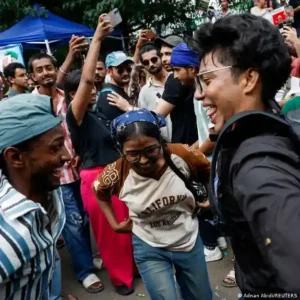
Image: Anushree Fadnavis/REUTERS
His sister, Priyanka Gandhi Vadra, said the development demonstrated that “an undemocratic and oppressive government was forced to bend to the will of the people.”
Former Delhi Chief Minister Arvind Kejriwal praised the protesters for their persistence, saying the government must learn to listen to citizens, while opposition lawmaker Shashi Tharoor said the resignation showed that accountability remains a cornerstone of democracy.
He, however, called for broader reforms to address the issues that triggered the unrest.
Celebrations erupted at the protest site in Jantar Mantar after news of the minister’s resignation broke, with demonstrators cheering and describing the outcome as “a victory of India’s youth.”
Activist Sonam Wangchuk, who is recovering in hospital after a 26-day hunger strike, also described the development as “a victory of democracy” and urged campaigners to shift their focus toward achieving lasting reforms.
Despite suspending the protests, the Cockroach Janta Party said some demands remain outstanding, including compensation for families of students who died by suicide and guarantees that no punitive action would be taken against student protesters.
CJP founder Abhijeet Dipke also called for disciplinary action against police officers accused of using excessive force during the demonstrations.
He urged supporters not to regard him as a hero, saying the movement’s success belonged to the people.
The protests began in early May after more than 2.2 million candidates sat for India’s National Eligibility cum Entrance Test for Undergraduate (NEET-UG), the country’s only entrance examination for undergraduate medical studies.
The exam, regarded as one of India’s most competitive, offers fewer than 150,000 medical school places, leaving millions of candidates competing for admission.
Days after the examination, allegations surfaced that the question paper had been leaked before the test.
Authorities subsequently cancelled the examination and scheduled a fresh sitting for June 21.
During the period between the cancellation and the rescheduled examination, Indian media reported that at least 20 students died by suicide amid fears of having to repeat the highly competitive test.
The controversy reignited public concern over recurring examination leaks, alleged corruption, exam manipulation and broader failures within India’s education system, eventually developing into a nationwide protest movement that culminated in the resignation of Education Minister Dharmendra Pradhan.
This is the first major concession by the Narendra Modi government in response to mass dissent, since it repealed the farm laws in 2021.
Source – DW
(vitalnewsngr.com)