
Hijrah, The Islamic New Year : A Time For Reflection, Renewal and Hope
By Abdulkarim Abdulmalik
As the sun sets on the final days of the Islamic year 1447 AH and Muslims around the world prepare to welcome 1448 AH, a profound moment of reflection arrives.
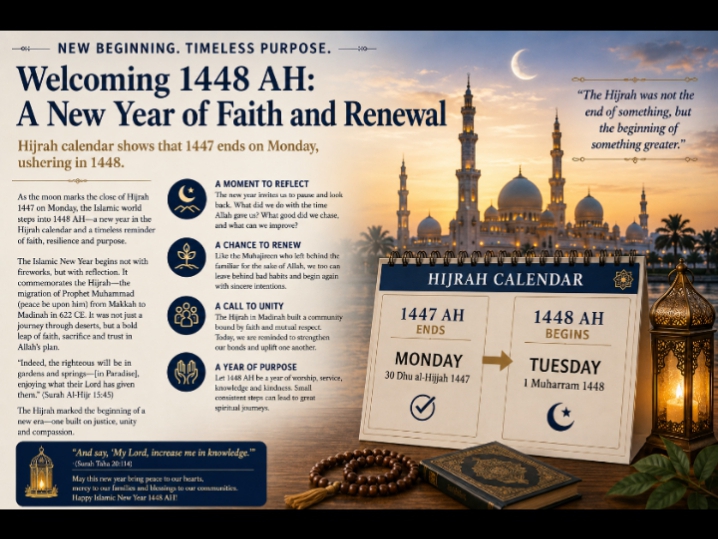
According to the Hijrah calendar, the year 1447 comes to an end on Monday, June 15, 2026, ushering in a new chapter in the Islamic lunar calendar.
Unlike many New Year celebrations characterized by fireworks, loud festivities and extravagant parties, the Islamic New Year invites believers to pause, reflect and renew their commitment to faith, humanity and righteous living.
The beginning of the Islamic calendar is not tied to the birth of a king, the victory of an empire or the establishment of a political dynasty.
Rather, it commemorates one of the most significant events in Islamic history—the Hijrah, or migration, of Prophet Muhammad (peace be upon him) and his companions from Makkah to Madinah in 622 CE.
This migration transformed a persecuted community into a thriving society founded on justice, coexistence and human dignity.
It marked the beginning of a new era in which faith was translated into social responsibility, ethical leadership and peaceful coexistence among diverse communities.
For Muslims, the arrival of Muharram, the first month of the Islamic calendar, is therefore more than a date change.
It is a reminder of sacrifice, perseverance and hope in the face of adversity.
*Lessons from the Hijrah*
The story of the Hijrah remains remarkably relevant in today’s world.
The Prophet Muhammad (peace be upon him) and his followers endured years of persecution, social isolation and economic hardship before eventually migrating to Madinah.
Yet they responded to hostility with patience, wisdom and strategic planning.
The Hijrah teaches that meaningful change often requires courage and sacrifice.
It demonstrates that difficult circumstances should not lead to despair but rather inspire resilience and determination.

In an era marked by insecurity, economic challenges, political tensions and social divisions, the message of the Hijrah speaks directly to contemporary realities.
It reminds individuals and nations alike that progress is possible when people remain steadfast in their values while adapting to changing circumstances.
For many Nigerians struggling with economic uncertainty, unemployment and insecurity, the Islamic New Year offers a message of hope.
Just as the early Muslim community overcame immense challenges through faith, unity and perseverance, societies today can overcome their difficulties through collective effort and responsible leadership.
*A Time for Personal Renewal*
The Islamic New Year also provides an opportunity for personal introspection.
While Islam does not prescribe elaborate celebrations for the occasion, scholars have long encouraged believers to assess their lives, review their actions and seek spiritual improvement.
As one year ends and another begins, Muslims are encouraged to ask themselves important questions.
Have they strengthened their relationship with God?
Have they fulfilled their obligations to family, neighbours and society? Have they contributed positively to their communities?
These reflections are not merely religious exercises.
They encourage personal accountability and ethical conduct, qualities that are essential for building healthy families and stable societies.
The transition from 1447 to 1448 AH therefore becomes a spiritual checkpoint—a moment to acknowledge past mistakes, seek forgiveness and set new goals for personal growth.
*Promoting Peace and Unity*
The significance of the Islamic New Year extends beyond individual spirituality.
The Hijrah itself was a remarkable example of community building and intergroup cooperation.
When the Prophet arrived in Madinah, he established agreements among Muslims, Jews and other communities, creating a framework for peaceful coexistence and mutual respect.
This historical experience offers valuable lessons for contemporary societies grappling with religious and ethnic tensions.
In Nigeria and across many parts of the world, communities continue to face challenges arising from mistrust, polarization and identity-based conflicts.
The values embodied in the Hijrah—dialogue, justice, compassion and inclusivity—provide a powerful blueprint for promoting peace and social harmony.
As Muslims welcome 1448 AH, there is an opportunity to renew commitments to interfaith understanding, community service and national development.
Faith should inspire constructive engagement rather than division.
*Muharram: One of Islam’s Sacred Months*
The Islamic New Year begins with Muharram, one of the four sacred months recognized in Islam.
These months are associated with heightened spiritual consciousness and moral responsibility.
The Prophet Muhammad (peace be upon him) encouraged voluntary fasting during Muharram, particularly on the Day of Ashura, which falls on the tenth day of the month.
Such acts of devotion remind believers that spiritual growth is a continuous journey rather than a seasonal event.
Muharram therefore serves as a gateway to a new year of worship, self-discipline and service to humanity.
*Looking Ahead to 1448 AH*
As Muslims around the globe bid farewell to 1447 AH and welcome 1448 AH, the occasion should inspire both gratitude and determination.
Gratitude for the blessings, opportunities and lessons of the past year; determination to become better individuals, stronger families and more compassionate communities.
The Islamic New Year is not merely about marking the passage of time.
It is about embracing the enduring lessons of the Hijrah—faith in times of uncertainty, courage in moments of difficulty and hope in the face of challenges.
In a world often overwhelmed by conflict, division and anxiety, the message of the Islamic New Year remains timeless: every ending carries the promise of a new beginning.
As the crescent moon heralds the arrival of 1448 AH, Muslims are reminded that true success lies not simply in counting the years that pass, but in ensuring that each passing year leaves them wiser, kinder and closer to both God and humanity.
May the new Islamic year bring peace, justice, prosperity and renewed hope for Nigeria and for the world.
*Abdulkarim Abdulmalik is an Abuja-based Journalist. Email : nowmalik@gmail.com*
(vitalnewsngr.com)