
The South African government has rejeced Nigeria’s demand for financial compensation regarding assets left behind by its citizens amid incessant xenophobic attacks.
The refusal comes after the Nigerian government announced it was recording the properties and investments of its repatriated nationals to present a formal claim to Pretoria.
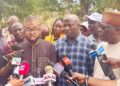
South African Minister in the Presidency, Khumbudzo Ntshavheni, clarified this in a press conference on Friday, July 3, where she stated that his country would not provide financial payouts, particularly for structures built in unregulated settlements.
““Informal squatter camps and settlements are never properties because they are illegal in the country.
“So, you are already violating our law if you tell us about a shack in an informal settlement.
“So, there is no compensation that will come from the government,” she stated.
Ntshavheni added that foreign nationals with legally registered assets were free to sell them through standard economic channels.
She further challenged the Nigerian government’s demand, citing alleged illegal activities by Nigerians in her country.
““We’ll be interested to know where the drug dens of Nigerians are so they can show us where they’ve been holding the drugs so that we can clean the drugs in South Africa quite urgently,” she said.
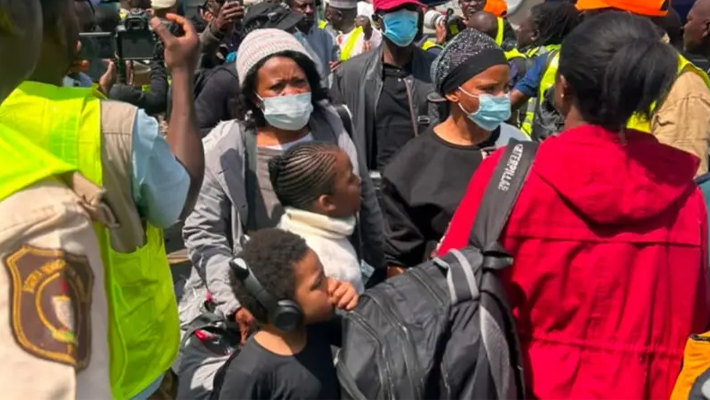
The diplomatic friction escalated following an evacuation programme that saw hundreds of Nigerians return home in a month due to targeted protests against undocumented foreigners.
Speaking during an interview with Channels TV on July 1, Nigeria’s Acting High Commissioner to South Africa, Temitope Ajayi, said the repatriation process would include legal follow-ups to protect the economic investments of Nigerian citizens.

““I have asked them before they left yesterday to document very accurately those things they were leaving behind in terms of businesses, in terms of even cars, movable and immovable properties.
“We can now take it up with the South African government. That is the next step we are going to take.
“”I told them to be very accurate with what they are going to give because we are going to work with the South African government to get to the exact locations of all these businesses, shops and properties and present them to the South African government for possible compensation because we will not allow the labour people have suffered to build over the years to just go down the drain or be taken over by people,” he added.
Xenophobic attacks in South Africa have led to several African countries evacuating their citizens from the southern African nation.
The attacks have led to the deaths of many immigrants and destruction of their businesses.
Many of the victims are tagged by South Africans as illegal immigrants despite holding valid papers.
Many South Africans, especially the youths, believe immigrants take over their jobs and other means of livelihoods.
South African President Cyril Ramaphosa recently vowed to crack down on groups behind the latest wave of violence in the country, as renewed anti-immigrant protests continued to trigger regional concern, diplomatic tensions and evacuation plans by affected countries.
Ramaphosa, in a televised address, said the government would not allow individuals or groups to exploit public frustration over illegal immigration to incite violence, lawlessness or political instability. However, his government has lauded the protests and described them as constitutional.
Nigeria, Ghana, Malawi, and Mozambique are among the countries that have evacuated their citizens.
Source – ICIR
(vitalnewsngr.com)