
By Kehinde Akinpelu
Ilorin
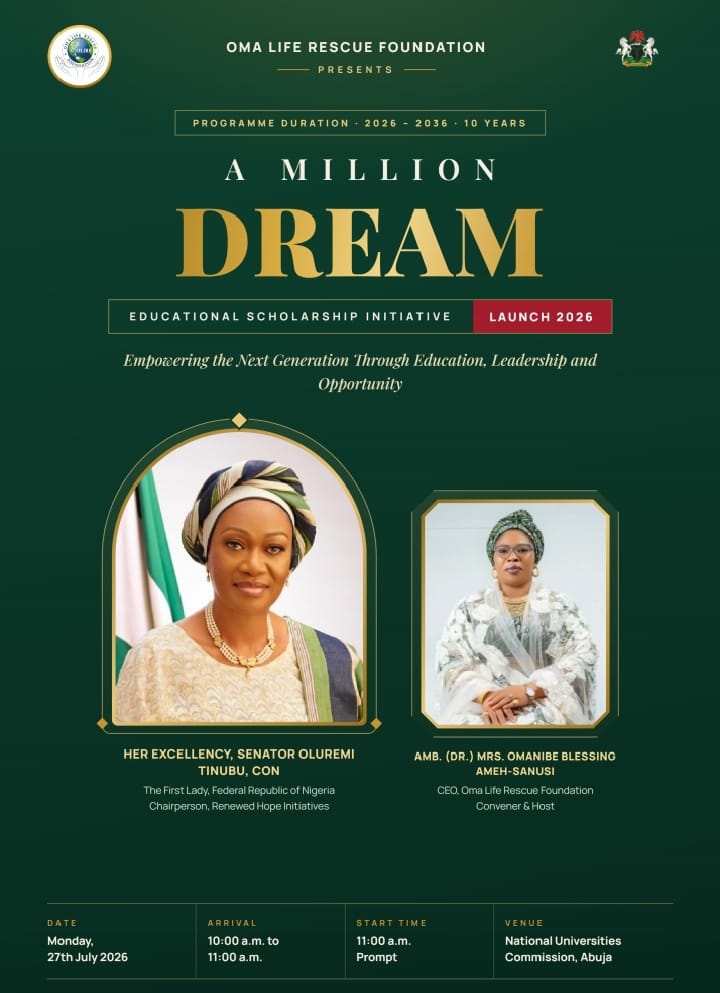
A non-governmental organisation, Oma Life Rescue Foundation (OLIRF), has announced Plans to award scholarships to one million Indigent Nigerian students over the next ten years.
The Founder and Chief Executive Officer of the Foundatiin, Dr (Mrs) Omanibe Ameh-Sanusi, announced this in a statement on Friday.
She said the scholaships will be awarded in collaboration with the Foundation’s
institutional and development partners.
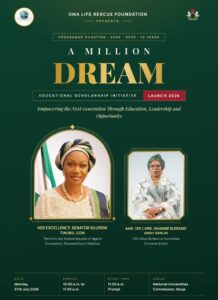
According to her, the scholarships will be provided under the Foundation’s ” A Million Dream Educational Scholarship Project.”
Speaking in a statement issued ahead of the official launch of the initiative scheduled for July 27, 2026, in Abuja, Ameh-Sanusi said dignitaries expected at the launch are the First Lady of the Federal Republic of Nigeria, Senator Oluremi Tinubu, as Special Guest of Honour; Minister of Education, Dr. Maruf Alausa; Minister of Humanitarian Affairs and Poverty Reduction, Minister of Women Affairs, Hajia Imaan Sulaiman-Ibrahim and the Minister of State for Budget and Economic Planning, Dr. Doris Uzoka-Anite.
Also exoected at the launched are Minister of State for the Federal Capital Territory, Dr. Mariya Mahmoud Bunkure; Executive Secretary of the National Commission for Almajiri and Out-of-School Children Education, Dr. Muhammad Idris; Secretary for Education, FCT Administration, Dr. Danlami Hayyo; Executive Secretary of UBEC, Aisha Garba; Vice-Chancellor of the University of Abuja, Hon. Abubakar Umar Tambuwal,Dr Adedolapo Fasawe,Representative of UNESCO in Nigeria, Dr. Jean-Paul Abiaga; Education Leader, Dr. Moronmubo Akinsile; Grand Kadi of Kwara State, Justice Kamaldeen Abdulkadir; and Chairman/Chief Executive Officer of Jeje-Ola Properties Nigeria Limited, Dr. Sanusi Jeje-Ola, among others
She explained that the programme is a long-term national educational intervention designed to expand access to quality education for brilliant but financially disadvantaged children and young people across Nigeria.

According to her, the project aims to support 100,000 beneficiaries annually from 2026 to 2036, with beneficiaries drawn from all six geopolitical zones of the country.
She explained that the scholarship structure has been carefully designed to ensure broad educational inclusion, with 30 per cent allocated to pupils in basic education (primary to junior secondary school), 50 per cent to senior secondary school students, and 20 per cent to students in tertiary institutions.
Ameh-Sanusi said priority would be given to academically outstanding students from low-income families, orphans and vulnerable children, students facing financial hardship, and young people who demonstrate discipline, character and exceptional academic potential.
“Our vision is to produce one million graduates over the next ten years,” she said.
“By supporting 100,000 students every year, we are creating a sustainable pathway to educational advancement, human capital development and national progress.”

She noted that the larger allocation to senior secondary school students reflects the critical transition stage into tertiary education, where many academically gifted students are unable to continue their education because of financial limitations.
“Our goal is to ensure that no brilliant child loses the opportunity to pursue higher education simply because of poverty,” she added.
The Foundation’s CEO disclosed that while the scholarship programme remains open to deserving students across various disciplines, some institutional and corporate partners have expressed interest in supporting courses that directly contribute to national development and economic growth.
These priority areas include Medicine, Nursing, Law, Engineering, Information Technology, Artificial Intelligence, Cybersecurity, Pharmaceutical Sciences, Accounting, Healthcare, Agriculture, Renewable Energy, Oil and Gas, and other strategic professions essential to Nigeria’s future.
She explained that academic excellence remains one of the programme’s principal selection criteria, adding that the initiative seeks to identify exceptionally talented students whose educational aspirations are threatened by financial hardship.
Ameh-Sanusi further explained that the scholarship programme has been designed as a 10-year intervention, allowing beneficiaries to receive support throughout the programme’s lifespan, subject to the scholarship guidelines and satisfactory academic performance.
She expressed optimism that by the end of the first decade, thousands of beneficiaries would have completed their education and become productive contributors to national development.
According to her, the programme will be reviewed at the end of the ten-year period, after which partners may decide to extend the initiative based on its impact and success.
“This is not a one-person project,” she said. “Its long-term success depends on governments, institutions, corporate organisations, philanthropists and individuals who believe that education remains one of the greatest investments any nation can make.”
Responding to concerns about whether the proposed ₦100,000 annual scholarship would be sufficient to meet students’ educational needs, Ameh-Sanusi explained that the financial award forms only one part of a broader support framework established with partner institutions.
She disclosed that the Foundation is collaborating with universities and educational institutions across Nigeria’s six geopolitical zones, many of which have agreed to provide tuition concessions and other forms of institutional support for scholarship beneficiaries.
According to her, these arrangements are intended to reduce the financial burden on students and enable the scholarship funds to address other essential educational needs.
She added that implementing a programme of this magnitude would require investments running into billions of naira over the next decade, making strategic partnerships essential to its sustainability.
Ameh-Sanusi commended the encouragement and technical collaboration already received from government institutions, educational stakeholders and development partners, while expressing confidence that additional organisations would join the initiative as its impact becomes evident.
“We have chosen to begin with the support already available rather than wait for every resource to be in place,” she said.
“We believe that as Nigerians witness the impact of this initiative, more partners will come on board.”
She stressed that the project is also aimed at restoring confidence in education among young Nigerians.
“Our nation needs educated, innovative and responsible young people.
“At a time when some youths are beginning to lose faith in education, we believe it is our collective responsibility to restore hope and demonstrate that education remains one of the most powerful tools for personal transformation and national development.”
Speaking on the Foundation’s background, Ameh-Sanusi described Oma Life Rescue Foundation as a non-governmental organisation committed to improving lives through sustainable humanitarian interventions.
She said the Foundation has, for well over a decade, implemented impactful programmes across Nigeria in education, healthcare, humanitarian assistance, youth empowerment, advocacy, emergency relief and child development.
“Our mission is to make the world a better place by sharing with love, while our vision is to positively affect and transform lives,” she said.
She described the A Million Dream Educational Scholarship Project as one of the Foundation’s flagship initiatives and expressed confidence that it would become a lasting legacy that would continue transforming lives for generations.
(vitalnewsngr.com)