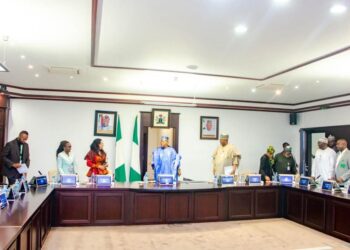

The President of Economic Community of West African States (ECOWAS), Dr. Omar Touray on Thursday said the Commission recorded notable economic, social, and institutional progress in 2025, despite global uncertainties and regional security challenges.
Speaking at a meeting with development partners, Touray said the regional economy grew by 4.6 percent in 2025, up from 4.3 percent in 2024, with projections of 5.0 percent growth in 2026.
He noted that this performance reflects the implementation of structural reforms, increased fiscal discipline, and measures to strengthen key sectors such as extractive industries and trade.
Touray said the regional inflation also eased from 24.4 percent in 2024 to 16.8 percent in 2025, supported by coordinated monetary and fiscal policies.
He highlighted improvements in budget management, with the regional deficit declining to 3.1 percent of GDP in 2025, adding that the debt-to-GDP ratio fell slightly to 45.7 percent.
He noted that current account balances remained positive, led by export surpluses from Nigeria, Ghana, and Guinea.
On the political and security front, Touray said ECOWAS strengthened peacekeeping and preventive diplomacy efforts across the region.
He revealed that missions in The Gambia and Guinea-Bissau assessed operational and financial implications, with recommendations for improved training, monitoring, and exit strategies.
He stated that counter-terrorism initiatives intensified following a rise in fatalities from attacks, with regional intelligence sharing and specialized training programmes expanded.
According to him, the arms control efforts also advanced with the donation of weapons-marking machines to four member states.
On trade and economic integration, Touray said ECOWAS continued to consolidate economic integration, advancing the free trade area, customs union, and common market initiatives.
He said efforts to facilitate cross-border trade included support for women and youth entrepreneurs, the rollout of the ECOWAS National Biometric Identity Card in six countries, and the launch of digital platforms to track trade compliance.
The region also participated in major trade fairs and forums, including the Intra-African Trade Fair in Algeria and the first ECOWAS Trade and Investment Forum in Lagos.

Touray noted that significant progress was made in energy, transport, and digital infrastructure, adding that clean energy programmes certified solar technicians, while broadband connectivity projects prepared the deployment of a second submarine cable.
He said ECOWAS also advanced regional road standards, aviation safety capacity, and interconnection hubs for internet access.
He said the Commission strengthened agricultural governance, climate-smart practices, and food security programs, reaching millions of beneficiaries with improved farming technologies, school feeding programmes and livestock development projects.
He also stated that partnerships on climate resilience, carbon markets, and sustainable resource management were expanded.
He added that through the West Africa Health Organization (WAHO), ECOWAS enhanced epidemic preparedness and laboratory capacities, stating that humanitarian support focused on vulnerable populations, including women cured of fistula and youth employability initiatives, including programmes on gender equality, women’s empowerment, and anti-trafficking capacity building were implemented in multiple member states.
Touray said ECOWAS strengthened internal governance, financial management, and staff capacity development, including training in strategic leadership and risk management.
He revealed that the ECOWAS Court of Justice held 79 sessions and increased public outreach to improve citizen access to justice.
International partnerships and diplomatic engagements with the UN, EU, World Bank, IMF, and AfDB yielded support for regional development projects across transport, agriculture, energy, and digital transformation.
He said he these achievements position ECOWAS to advance regional integration, economic growth, and stability, despite ongoing challenges such as geopolitical tensions, security threats, and the withdrawal of Burkina Faso, Mali, and Niger from the Community.
(vitalnewsngr.com)